
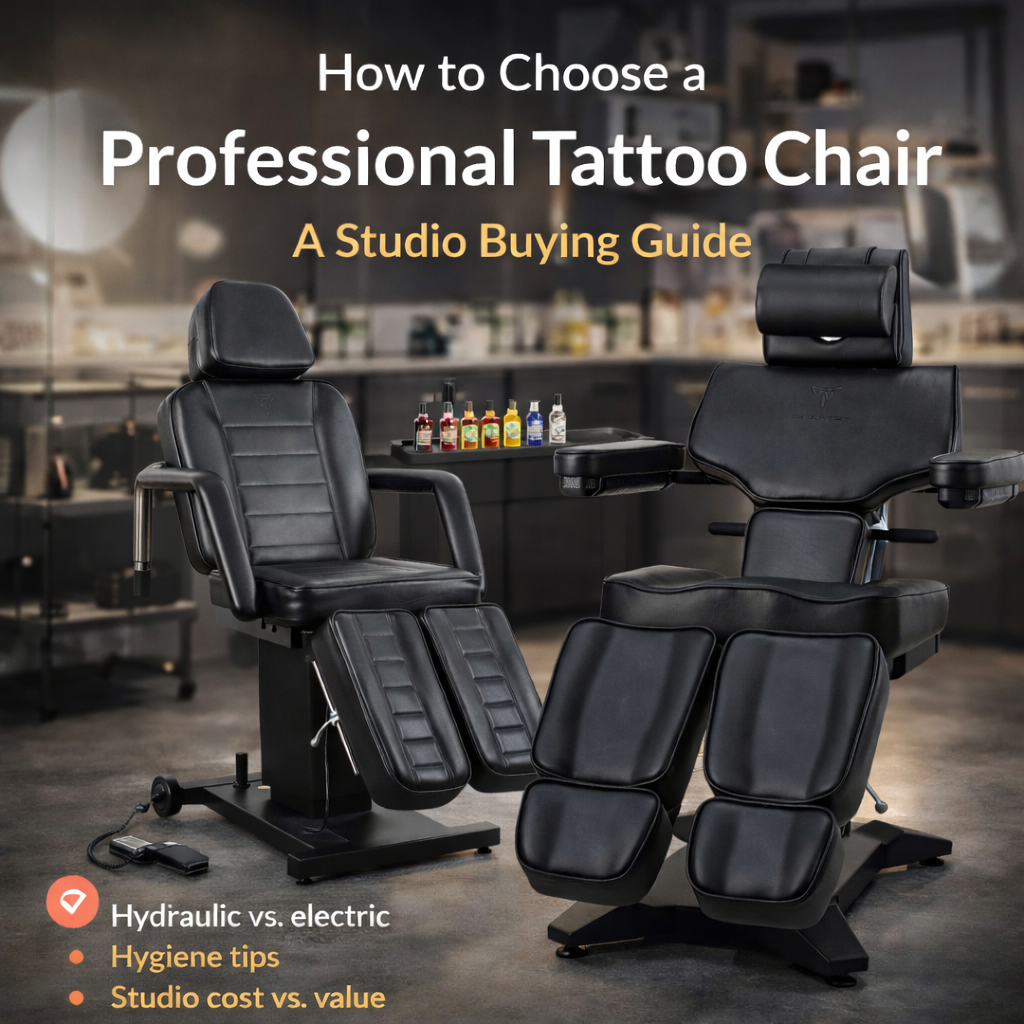
How to Choose a Professional Tattoo Chair: A Studio Buying Guide
In a tattoo studio, a chair isn’t “just furniture.” It’s your work platform. The right tattoo client chair improves client comfort during long sessions, speeds up positioning between angles, supports cleaner workflows, and protects your body over years of work.
This guide breaks down what matters most when buying a professional tattoo chair—then makes it easy to pick the right model based on your studio stage, budget, and space.
Quick Jump
- 1-Minute Match: Which Chair Fits Your Studio?
- The 5 Factors That Actually Matter
- The 3-Minute “Real Studio” Test (Before You Buy)
- Recommendations by Studio Type
- Common Buying Mistakes
- Care & Maintenance Tips
- ROI: Why a Better Chair Usually Costs Less Long-Term
- Chair Buying Checklist
- FAQ
1-Minute Match: Which Chair Fits Your Studio?
If you want the fastest decision: pick the row that sounds like your studio, then click through to the matching chair. You can also browse the full collection here:

| Your situation | Best match | Recommended model (click to view) | What to prioritize |
|---|---|---|---|
|
High-end private studio / premium clients Long sessions, high expectations, “premium look” matters |
Flagship hydraulic chair with fast positioning + clean finish |
TA-TC-604 ($1299) Built for long sessions with quick position changes, full-chair swivel, split-leg access, and a premium, wipe-down-friendly station look. |
Positioning speed, stability, wipe-down surfaces, repeatable angles |
|
Established studio upgrade You want a consistent setup and a more “pro” studio feel |
Durable hydraulic upgrade that’s easy to run daily |
TA-TC-04 PRO A studio workhorse: multi-position flexibility, solid frame feel, and a clean black finish that suits most shop aesthetics. |
Durability, daily workflow speed, easy maintenance, long-term value |
|
New studio / tight budget You need a strong main chair without overspending |
Best-value hydraulic chair (the “buy once, use daily” pick) |
TA-TC-22C ($799) Practical adjustability and 360° rotation—great for a first serious chair that still feels professional. |
Stability, easy cleaning, reliable lift, essential adjustability |
|
Small booth / tight walkways Limited room, you want a straightforward setup |
Simple, heavy-duty hydraulic chair that keeps your station efficient |
TA-TC-22 ($699) A no-nonsense hydraulic chair built for long sessions and quick setup—pair it with good station layout and it stays smooth in smaller rooms. |
Footprint planning, station layout, stable base feel, fast adjustments |
Quick rule: If you’re doing premium, long-session work and want the most flexible access, start with TA-TC-604. If you’re building your first serious setup, start with TA-TC-22C.
The 5 Factors That Actually Matter
1) Lift & positioning: smooth, stable, repeatable
Hydraulic chairs are popular because they’re straightforward and reliable—especially if you’re constantly changing angles. What matters isn’t how long the spec sheet is. It’s whether the chair stays steady and predictable while you work.
- Smooth lift (under load): test with someone seated—no sudden drops or jerky movement.
- Position holds: you shouldn’t feel slow sinking after you set a height or angle.
- Fast workflow controls: foot pump placement and adjustment points should feel natural.
Model tie-in: If fast angle changes are your daily reality, TA-TC-604 is designed around repeatable positioning with full-chair swivel and split-leg access.
2) Ergonomics: comfort for the client, access for the artist
The best chair is the one that lets your client stay still (comfort + support) while giving you clean access without awkward body angles.
- Look for adjustment where you actually need it: backrest, leg support, headrest.
- Prioritize “stable comfort” over “super soft.” Too-soft cushions can cause shifting.
- Make sure you can approach from your working angles without fighting the chair.
3) Hygiene & cleaning speed: fewer dead zones = faster turnover
In real studios, the chair you can wipe down fast is the chair you’ll love long-term. Seams, tight corners, and complicated joints become time sinks—and hygiene risks.
- Choose surfaces that tolerate frequent wipe-downs and don’t trap ink or residue.
- Scan for “dead zones”: around hinges, under arm supports, between cushions, and at seams.
- Ask what cleaners are recommended (and what to avoid) to protect the finish.

4) Stability: the chair shouldn’t wobble when the client shifts
Stability is not optional. If the chair moves every time a client breathes or repositions, it affects your line quality and your fatigue level.
- Test the base: sit, recline, lift legs—does it still feel planted?
- If you use casters, make sure they lock and hold under movement.
- Heavier-duty builds usually feel calmer during long sessions.
Model tie-in: For bigger clients and heavy-duty use, TA-TC-22 is rated for high load and built for long sessions.
5) Fit for your studio: space, style, and daily workflow
The “best” chair is the one that fits your room and your style of work. A high-end chair in a cramped booth can feel worse than a simpler chair with clean station layout.
- Measure your available footprint and walkways (including door clearances).
- Think about your most common tattoo placements (legs, back, arms) and how often you reposition.
- Match the chair’s look to your studio’s vibe—premium matters if you sell premium.
The 3-Minute “Real Studio” Test (Before You Buy)
- Load test first: have someone sit on it, then lift and recline. Smooth under load is the real standard.
- Hold test: set a height/angle and wait 20–30 seconds—no slow sinking.
- Access test: simulate your working angle (knee work, calf, back). Can you approach without twisting your torso?
- Wipe test: run your hand along seams/joints—if your fingers catch, your wipes will too.
- Stability test: shift weight and move legs—does the chair stay calm and planted?
Pro move: If your studio is tight, prioritize chairs that reduce “move the chair” moments. Full-chair swivel and access-friendly design can be a bigger win than extra features.
Recommendations by Studio Type
New studio (budget-focused): start with one solid “main chair”
If you’re opening a shop or rebuilding your setup, buy one chair you can use every day without fighting it. That usually means stability + cleaning speed + essential adjustability.
Best value pick: TA-TC-22C — practical, pro-feeling adjustability with 360° rotation.
Established studio upgrade: unify your look and workflow
When you’re busy, you don’t want “fussy” equipment. You want chairs that run smoothly, clean quickly, and look consistent in your content and client photos.
Upgrade pick: TA-TC-04 PRO — multi-position flexibility with a daily-studio workflow mindset.
High-end private studio: premium sessions deserve premium positioning
If you sell a premium experience, clients notice details: how steady the chair feels, how clean the station looks, and how smoothly you reposition without interrupting the session.
Flagship pick: TA-TC-604 — designed for long sessions and fast positioning, with full-chair swivel and split-leg access.
Small booths / tight walkways: keep the station efficient
In a smaller space, your chair choice and station layout go together. If you want a straightforward, heavy-duty hydraulic chair and a clean workflow, choose a model that stays stable and doesn’t slow your movement.
Small-station friendly pick: TA-TC-22 — simple setup, built for long sessions, and rated for heavy-duty use.
Common Buying Mistakes
- ❌ Buying on price alone: the cheapest chair often costs more in replacements, lost time, and client discomfort.
- ❌ Ignoring cleaning speed: “dead zones” add minutes every session—those minutes stack up fast.
- ❌ Not testing under load: a chair can feel great empty and fail when a client sits down.
- ❌ Over-buying features: if you won’t use it weekly, it’s probably not worth paying for.
Care & Maintenance Tips (simple and realistic)
- After each client: wipe high-touch surfaces (arm supports, headrest, seat edges) with studio-safe cleaners.
- Weekly: check joints and fasteners; tighten anything that’s loosening over time.
- Monthly: inspect casters/locks (if used) and clean hair/dust from moving parts.
- Avoid harsh solvents: they can damage finishes over time—use cleaner recommendations that fit your upholstery.
ROI: Why a Better Chair Usually Costs Less Long-Term
A chair pays you back in three ways: fewer interruptions, faster turnover, and better client comfort. If you tattoo most days of the week, even small workflow improvements become real money—and real energy saved.
For premium studios, the chair also shows up in reviews: “comfortable,” “clean,” “professional.” Those words are marketing you don’t have to buy.
Tattoo Chair Buying Checklist (save this)
- ✅ Measure your room footprint and walkways (including door clearance)
- ✅ List your must-have adjustments (back, legs, head, swivel)
- ✅ Do the 3-minute test: load → hold → access → wipe → stability
- ✅ Confirm warranty coverage and return policy
- ✅ Pick the chair that matches your studio stage:
- New studio value: TA-TC-22C
- Established upgrade: TA-TC-04 PRO
- Premium private studio: TA-TC-604
- Small-station workflow: TA-TC-22
FAQ
Is a hydraulic tattoo chair better than an electric one?
Hydraulic chairs are popular for their simplicity and reliability. Electric chairs can be great too, but they often come with higher maintenance expectations. Choose based on your workflow, positioning needs, and support options.
Do I really need a chair that rotates?
If you regularly change angles (and most artists do), rotation can save your back and speed up your sessions. It reduces how often you have to physically reposition the chair.
What matters more: softer cushioning or firmer support?
Support wins. “Too soft” can lead to shifting and micro-movement. A chair should feel comfortable but stable—especially for long sessions.
How do I know if a chair is easy to clean?
Look for fewer seams and fewer tight joints. If your hand catches in a spot, your wipe will too. Prioritize wipe-down speed in real workflows.
Which chair is best for premium, long sessions?
If premium positioning, access, and a clean station look are priorities, start with TA-TC-604.
Which chair is best for a new studio?
If you want strong value with practical adjustability, TA-TC-22C is a smart first “main chair.”
How should I plan for a small booth?
Measure your walkways first. Then prioritize a stable chair and a clean station layout so you can work without constantly moving furniture. If you want a simple heavy-duty setup, TA-TC-22 is a straightforward pick.
Want help choosing the right chair?
Send us 4 details—room size, what you tattoo most, budget range, and how many stations—and we’ll point you to the best match.