
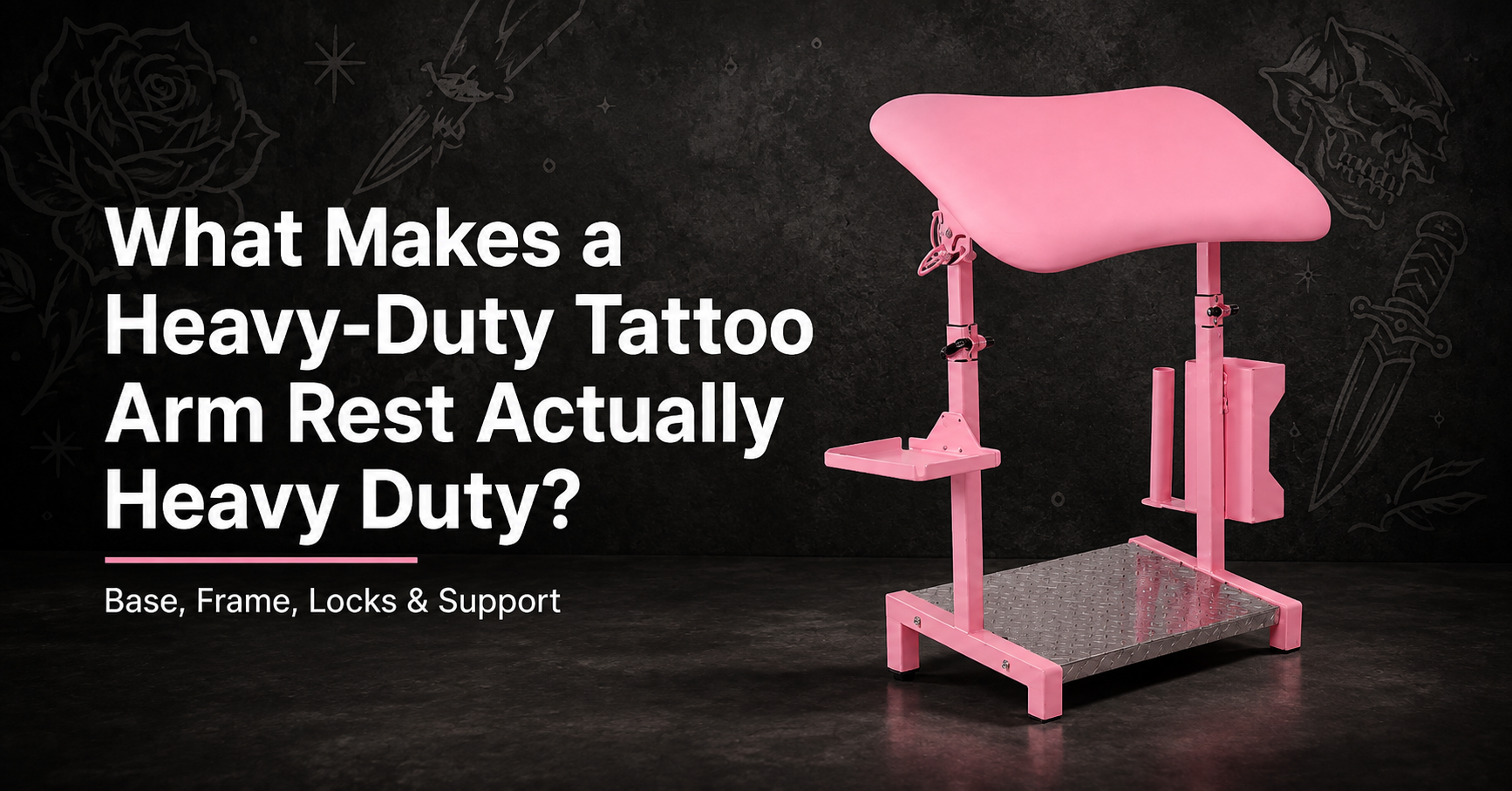
A heavy-duty tattoo arm rest should mean more than a product that simply looks large or weighs more than another model.
True stability comes from the complete structure: the base, frame, adjustment joints, locking mechanisms, cushion mount and padding all work together to support the client and keep the working area steady.
Terms such as “heavy duty,” “professional,” “reinforced,” “stable” and “XL” appear frequently in tattoo furniture listings. But these labels do not tell an artist exactly why a product is stable or whether it will remain practical through long sessions and repeated daily adjustment.
A professional tattoo arm rest should perform well where it actually matters: under pressure, at real working height and during repeated use.
The following factors are more useful than a marketing label when evaluating whether an arm rest is truly built for professional studio work.
1. Start With the Base Design
The base is one of the most important parts of a tattoo arm rest because it transfers the load from the client and cushion into the floor.
A heavier base can help create a planted feel, but weight alone does not determine stability.
The overall footprint matters just as much.
Important details include:
- Base width
- Base depth
- Floor-contact points
- Center of gravity
- Foot positioning
- Anti-slip contact
- Base shape
A narrow base can still feel unstable even when made from relatively heavy material. If pressure is applied near the edge of the cushion, the structure may rock or lift if the load moves too far away from the center of the base.
The same applies when the support is raised. A taller position increases the leverage applied to the frame and base.
A Quick Base Check
Once an arm rest is assembled, set it at a normal working height and apply controlled pressure to several areas of the cushion:
- Center
- Left edge
- Right edge
- Front edge
Watch the base while doing this.
A properly placed arm rest should not show obvious lifting, sliding or excessive rocking under normal working pressure.
Floor condition matters too. A stable structure can still behave poorly on an uneven or slippery surface.
A heavy base helps, but a well-designed footprint matters just as much as total weight.
2. Frame Construction Matters More Than Appearance
A tattoo arm rest can look substantial in a product photo while still having weak points in its frame.
The frame carries pressure from the cushion down into the base. If any section flexes too much or has a loose connection, the movement becomes noticeable at the top.
When evaluating frame construction, look at:
- Metal tubing
- Tube thickness
- Welded joints
- Upright posts
- Cross connections
- Mounting points
- Fasteners
The most useful way to think about the structure is to follow the path of the load.
When a client rests an arm or leg on the cushion, the pressure travels through:
Cushion → Bracket → Vertical Post → Base → Floor
Every connection in that path matters.
A thick cushion and heavy base cannot fully compensate for a weak mounting bracket or loose post connection.
The same is true for welded joints. Weld quality, alignment and reinforcement influence how the frame behaves under repeated pressure.
A heavy-duty structure should feel solid as one complete system rather than as several individual parts connected loosely together.
3. The Weakest Point Is Often the Adjustment Joint
One of the most overlooked sources of movement is the adjustment system.
The base may sit firmly on the floor, but the cushion can still move if there is play in the adjustable sections above it.
Common movement points include:
- Telescopic height connections
- Tilt mechanisms
- Rotation joints
- Locking knobs
- Cushion mounting brackets
A small amount of looseness near the base may feel minor. The same amount of movement near the cushion becomes much more noticeable to the artist.
This is especially important in detailed tattoo work where the client’s limb needs to remain in a predictable position.
What to Check
After setting the arm rest to a working position:
- Push the vertical post gently from side to side.
- Check whether the inner post moves inside the outer tube.
- Lock the cushion angle and apply light downward pressure.
- Try rotating the cushion after the rotation control is locked.
- Check whether the mounting bracket shifts.
A heavy-duty arm rest should not rely on base weight alone. Its adjustment points should also remain secure.
A heavy-duty tattoo arm rest should remain stable at its adjustment points, not only at its base.
4. Stability Should Be Tested at Working Height
Product photos often show tattoo arm rests at a low or medium position because this looks more balanced visually.
That does not necessarily represent how the equipment will be used.
As the cushion rises:
- The center of gravity moves upward.
- Leverage on the vertical post increases.
- Small amounts of play become easier to notice.
- Side pressure places more stress on the frame.
For this reason, stability should be checked at the height the artist actually uses.
Three-Height Stability Test
A simple practical test is to check three positions:
- Minimum height
- Normal working height
- Maximum intended working height
At each position, inspect:
- Base movement
- Vertical-post movement
- Cushion movement
- Tilt-lock performance
- Rotation-lock performance
The goal is not to expect a completely motionless structure under every possible force. Any adjustable piece of furniture has some physical tolerance.
The important question is whether the movement becomes noticeable enough to affect client positioning or the artist’s control.
Testing only at the lowest position can hide problems that become visible once the arm rest is raised.
5. Cushion Size Also Affects Stability
A larger cushion gives the client more support, but it also creates more leverage on the frame.
This matters when pressure is placed near the edge of the cushion. The farther the load moves from the center post, the more stress is placed on the bracket and locking system.
For larger cushions, check:
- Base size
- Cushion bracket
- Tilt lock
- Frame stability
A larger cushion is useful only when the structure can support it properly.
6. Locking Mechanisms Need to Hold Firmly
Adjustment range is useful only if the arm rest stays in place after adjustment.
Check whether the:
- Height lock stays secure
- Cushion holds its tilt angle
- Rotation lock prevents unwanted movement
- Knobs and clamps are easy to tighten
Do not judge an arm rest only by how much it can tilt or rotate. What matters is whether it stays stable after locking.
7. Heavy Duty Should Still Be Easy to Adjust
A heavy-duty arm rest should feel solid, but it should not be difficult to use.
A good design should offer:
- Easy height adjustment
- Simple angle changes
- Firm locking after adjustment
- Consistent operation
Whether the system is manual or pneumatic matters less than how well it works during daily use.
8. Padding Matters Too
The metal frame is only part of the structure. The cushion also needs to hold its shape.
Check for:
- Even firmness
- Good foam recovery
- Edge support
- Consistent padding
If the cushion sinks too much or becomes uneven, the client’s arm or leg may move during the session.
A heavy-duty arm rest should remain supportive both inside and outside.
9. Think About Repeated Use, Not Just Weight Capacity
Maximum load is only one specification.
In real studio use, an arm rest may be adjusted and loaded many times each day. It also needs to handle long sessions and repeated repositioning.
Pay attention to how well the product maintains:
- Frame stability
- Locking performance
- Cushion shape
- Adjustment accuracy
For professional use, consistent performance over time matters more than one maximum-load number.
10. Heavy Duty Should Still Fit the Studio
A larger base can improve stability, but it should not make the workstation harder to use.
Before buying, make sure the arm rest does not block:
- The artist stool
- Foot pedal
- Workstation trolley
- Client walkway
A professional arm rest should be stable without taking over the entire working area.
11. Quick Heavy-Duty Tattoo Arm Rest Checklist
Before buying, check:
- Base size and floor contact
- Frame and post stability
- Cushion bracket
- Height, tilt and rotation locks
- Stability at normal working height
- Cushion support
- Maintenance access
The goal is not to find the heaviest arm rest. It is to find one that stays stable, adjusts easily and fits the workstation.
Frequently Asked Questions
Does a heavier tattoo arm rest mean it is more stable?
Not always. Weight helps, but base design, frame structure and locking systems also affect stability.
Is an XL tattoo arm rest always heavy duty?
No. A larger cushion needs a strong bracket, stable frame and suitable base.
How can I check tattoo arm rest stability?
Test it at your normal working height and apply light pressure to the center and edges of the cushion. Check for movement at the base, post and adjustment joints.
Conclusion
“Heavy duty” should describe the whole structure, not just the weight.
A reliable tattoo arm rest needs a stable base, solid frame, secure adjustment joints and supportive padding. It should also stay practical during daily use.
For artists who need a larger support surface for arms, legs or longer sessions, you can also explore our XL Tattoo Arm Rest & Foot Rest.