
You can have a reliable machine, a clear stencil, and a well-planned design, yet still spend the session fighting for a usable angle. The client keeps shifting. Your stool ends up too far from the skin. You move the armrest again, circle the chair, and settle for a position that works for the tattoo but not for your body.
That is why the client chair matters more than it first appears. It determines where the tattooed area sits, how securely the client can hold a position, and whether the artist can approach from the angle the design requires. The right chair does not perform the work for you. It removes avoidable obstacles so your attention can stay on the tattoo.
A Tattoo Chair Is Part of the Artist's Workflow
A tattoo chair is not simply where the client sits. It controls where the tattooed area is positioned, how easily the artist can access the work, and how smoothly the session can adapt when the tattoo placement changes.
Start With the Tattoo Area, Not the Chair Features
Every tattoo placement creates a different working challenge. The chair should help bring each body area into a stable working zone instead of forcing every tattoo into one fixed position.
Before adjusting anything, decide where the tattooed area needs to be in relation to your eyes, shoulders, elbows, and dominant hand. A back piece, inner forearm, thigh, calf, and sternum do not ask for the same client posture. The chair should help bring each area into a stable working zone rather than forcing you to build every tattoo around one fixed seat position.
A practical setup sequence is:
Place the client in a position they can maintain without continuous muscle effort
Adjust the tattooed area to a comfortable viewing and reaching height
Rotate or reposition the chair so the artist can approach without twisting around the base
Support the relevant limb before arranging the light, stool, armrest, and tray
Ask the client to confirm comfort, then test the setup from the artist's actual working position
Do this before preparing to tattoo. Once the machine is running, artists often tolerate a poor angle longer than they should because stopping to rebuild the setup interrupts concentration.
1.For Upper Arm and Shoulder Work
Upper-arm and shoulder tattoos often require access from more than one direction. The client may begin upright or slightly reclined, but the artist may still need to move from the front of the arm to the side or rear as the design wraps around.
A chair that rotates through 360 degrees can turn the client toward the working side instead of making the artist drag the stool, light, and tray around the room. Rotation is most useful as a reset between stages: pause the work, move the chair to the new angle, confirm that the base is stable, and then reposition the light and supplies. The chair should not be rotated while the needle is on the skin.
2.For Chest Abdomen and Side Torso Work
Torso work can become difficult when the client is too upright to relax but too flat for the artist to see the surface clearly. An adjustable backrest with a 0 to 76 degree range allows the client to move from seated toward reclined positions. The useful setting is the one that exposes the tattoo area while keeping the client supported and the artist's line of sight clear.
For side-torso work, small changes can matter more than a dramatic recline. Rotate the chair so the working side faces the artist, adjust the backrest until the skin is accessible, and make sure the client's upper body remains stable. Avoid asking the client to hold a long unsupported twist simply because it creates a better view for a few minutes.
3.For Back Tattoos and Forward Leaning Positions
Back tattoos often tempt artists to place the client on a stool and ask them to lean forward. That may expose the area, but the client can gradually round, shift, or become tired, changing the skin tension and working height during the session.
A chest support that adjusts from 0 to 40 degrees can help support a forward-leaning position when used according to the product instructions. The goal is not to press the client into the support. It is to give the upper body a stable place to rest so the client does not have to hold the posture through muscle effort alone. Check breathing comfort, pressure points, and access to the back before beginning.
4.For Thigh Knee Calf and Lower Leg Work
Lower-body tattoos can become awkward when the working leg is not fully supported or the other leg blocks the artist’s approach. Before placing your stool and foot pedal, position the client so you can move close to the tattoo area without reaching across the chair.
For thigh work, the leg usually needs a relaxed, supported position that keeps the skin easy to reach. Calf and ankle tattoos often require the lower leg to sit at a different angle or height. This is where separately adjustable leg sections can be useful: the working leg can be positioned for access while the other remains supported and out of the way.
Adjust one section at a time and support the client’s leg while moving it. Then sit in your actual working position and check your sightline, reach, stool clearance, and pedal placement. A suitable tattoo chair should let you adjust each leg independently and bring the lower leg closer to your working height without forcing the client into an uncomfortable position.
5.For Long Sessions and Position Changes
A long appointment rarely stays in one position from stencil to final wipe. The artist moves closer for detail, sits back to check composition, changes sides, and may need to adjust the client as swelling or fatigue develops. A foot-operated hydraulic lift with an 18 cm height range allows the working height to be reset without turning the chair adjustment into a complicated process.
Use height changes at natural pauses. Raise or lower the client before a new section, then check your shoulders, elbows, sightline, and foot position. The purpose is not to keep adjusting for its own sake. It is to prevent a workable setup from slowly becoming an uncomfortable one as the session changes.
6.Protect the Artist's Working Space
Client comfort matters, but the chair also has to leave a usable zone for the artist. Before the client sits down, allow room for the stool to approach the chair, the foot pedal to remain reachable, the light to move, and the artist to exit either side without stepping over equipment.
A rotating chair can reduce unnecessary travel around the client, but only if the surrounding space is clear. A split-leg design can improve access to one leg, but only if the unused section and base do not block the stool. Position the chair first, then build the rest of the workstation around the tattoo area rather than around the wall or cabinet.
What Professional Tattoo Artists Should Look for in a Client Chair
The most important factor is not the number of adjustments. It is whether the chair supports real tattoo workflows through stable positioning, accessibility, and efficient movement around the client.
1.Buying for Appearance Before Testing Access
A chair may look right in a studio photo but leave no room for the stool near the working side. Check the base footprint, armrest position, and leg sections from the artist's seated position, not only from the client's point of view.
2.Choosing Maximum Adjustment Instead of Usable Adjustment
A large adjustment range matters only when the mechanisms hold securely and the positions match the tattoos you perform. Pay attention to the middle settings where most sessions happen, not only the most dramatic recline or extension.
3.Treating Weight Capacity as a Complete Fit Guide
Capacity is an operating limit, not a guarantee of fit. Seat dimensions, body proportions, mobility, transfer needs, and the intended tattoo position also determine whether a chair is suitable for a particular client.
4.Ignoring How the Chair Changes the Room
Rotation, recline, and extended leg sections require clearance. Measure the chair in the positions you expect to use, then account for the stool, light, workstation, cords, and a safe path for both artist and client.
5.Expecting the Chair to Fix the Entire Setup
A client chair cannot correct poor lighting, a distant tray, unsupported artist seating, or a schedule with no position breaks. It should work with the rest of the station and make good setup choices easier to maintain.
Why Choose the TA-TC-604 Tattoo Client Chair
The Value Is in Supporting the Workflow
A professional tattoo chair should remove obstacles during a session. Its purpose is to help artists maintain access, control positioning, and focus on creating the tattoo.
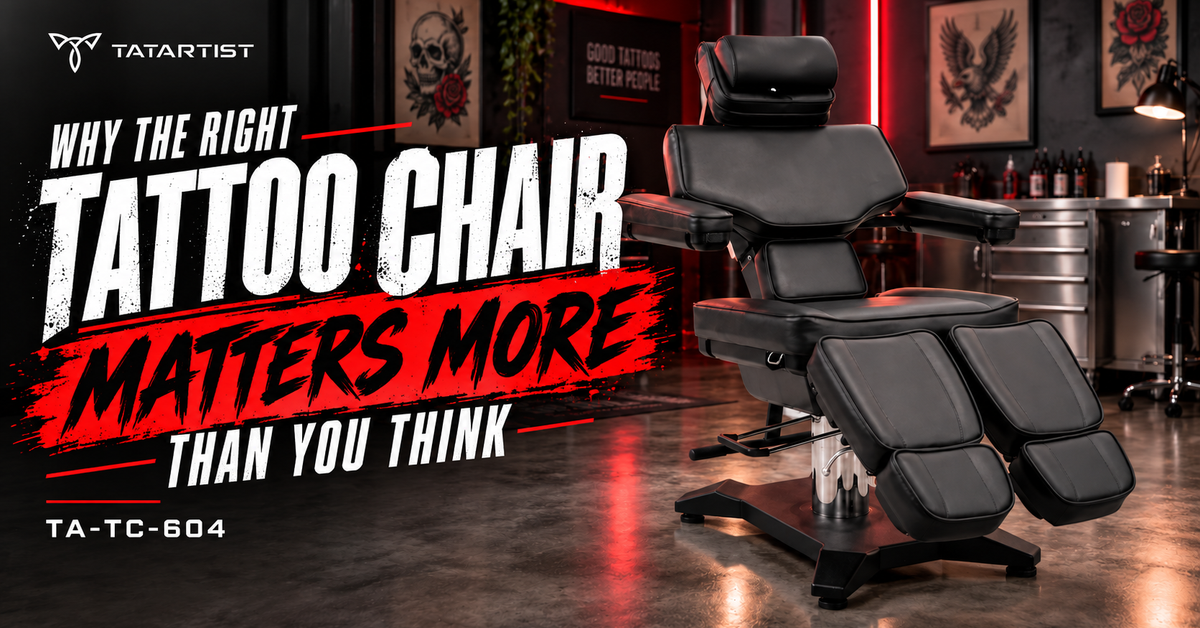
The TA-TC-604 is designed for studios that work across multiple tattoo areas and need one client chair to move between upright, reclined, forward-supported, and independent leg positions. The backrest adjusts from 0 to 76 degrees, the chest support from 0 to 40 degrees, the leg sections extend from 0 to 16 cm, and the lower-leg supports adjust from 0 to 80 degrees.
Those ranges matter because artists do not tattoo a generic body position. They tattoo a shoulder that needs to turn, a back that needs to remain exposed, or a calf that needs to sit at the right height. The chair becomes useful when each adjustment solves a real access problem and can be reset for the next body area.

Stability Matters More as the Chair Adjusts
An adjustable chair must remain dependable through more than one position. As the backrest reclines, a leg section extends, or the chair rotates, the client's weight shifts. A stated capacity of 200 kg or 440 lb provides a clear operating limit, but capacity alone is not the full stability story. The base, hydraulic system, joints, locks, and moving sections must also feel secure in the positions the studio uses most often.
Before every appointment, check that the chair sits level, the rotating mechanism is secure, the supports hold their selected positions, and no moving section has looseness or visible damage. After any major adjustment, apply gentle pressure and confirm stability before the client fully transfers their weight.

A Better Setup Can Support Client Confidence
Clients may not understand every chair control, but they notice when a position feels improvised. Repeatedly asking them to scoot, hold a limb in the air, or maintain an unsupported lean can make a long session feel less controlled. A chair that supports the chosen posture helps the client settle, which can reduce avoidable movement and make instructions easier to follow.
This does not mean the client should remain motionless for hours. Planned breaks and position checks still matter. The benefit is that the working position has a stable starting point rather than depending on the client to hold themselves in place.
The Chair Supports the Workflow but Does Not Replace It
No chair can correct poor lighting, a distant tray, rushed setup, or hours without a position change. The product is most valuable when the studio already treats client positioning as part of the tattoo process. Use the adjustment range deliberately, keep the artist's movement path clear, and reset the chair whenever the tattoo area changes.
Frequently Asked Questions
Is a fully reclined position best for every tattoo
No. The best position depends on the tattoo area, the artist's line of sight, client comfort, and access around the chair. Use only as much recline as the current body area requires.
Why are independently adjustable leg sections useful
They allow one leg to be positioned for access while the other remains supported. This can be helpful for thigh, knee, calf, ankle, and other lower-body placements where a single fixed leg position limits the artist's approach.
Does a 200 kg capacity mean every client under that weight will fit comfortably
Not necessarily. Weight capacity is an operating limit, not a guarantee of body fit or comfort. The studio should also consider seat dimensions, client proportions, transfer needs, and the positions required for the tattoo.
Final Takeaway
Why the right tattoo chair matters more than you think comes down to one practical point: the chair controls where the work happens. It affects whether the client can stay supported, whether the tattoo area remains accessible, and whether the artist can maintain a clear working zone as the session changes.
Choose adjustments because they solve the positions you use in real appointments. Use rotation to bring a new side toward you, not to move a client during tattooing. Use the backrest and chest support to create maintainable upper-body positions. Use independent leg sections to support the limb and open the artist's approach. Use the hydraulic lift to keep the work near a comfortable viewing and reaching height.
A suitable chair gives the artist more control over where the work happens. It helps bring different body areas into a stable working zone while giving the client a position they can realistically maintain. That is the role TA-TC-604 Tattoo Client Chair is designed to support.
The right tattoo chair does not replace an artist's skill. It creates a more predictable working environment where the client stays supported and the artist can maintain clear access as the session changes. A suitable chair becomes part of the tattoo workflow.