
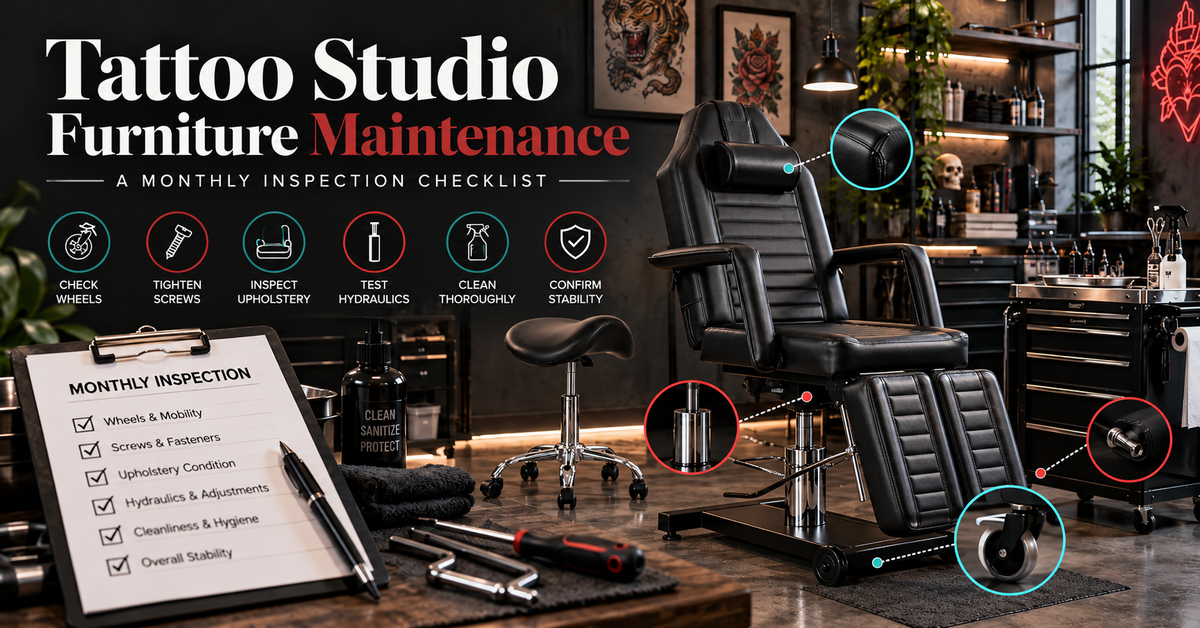
A stool starts to wobble, a drawer catches, or a chair control responds inconsistently. These small changes deserve attention before the next appointment. A planned furniture inspection helps you spot wear, record faults, and arrange the right follow-up.
Use a monthly review to organize checks of client chairs, armrests, artist stools, workstations, and carts. Follow each product’s maintenance schedule, and address new damage or unusual operation immediately rather than waiting for the next review.
Inspect Upholstery and Padding
Look along cushion edges, seams, backrests, and leg rests for cracking, peeling, tears, and loose stitching. Check the areas around adjustment handles and other points where the covering may rub against nearby components. Note flattened or uneven padding as well as damage to the outer surface.
Review the care instructions before changing cleaning products. Compatibility depends on the upholstery and finish, so a product used successfully on a metal tray may not be suitable for a chair cushion. Keep the manufacturer’s care guidance available to the people who clean the furniture.
Record any exposed padding or damaged covering for assessment. A repair decision should account for whether the surface can be maintained appropriately, as well as whether the cushion still provides support.

Check Frames, Bases, and Casters
Inspect the base, frame, joints, and accessible fasteners for cracks, bending, corrosion, or looseness. On adjustable furniture, include hinges and pivot points. If a chair or stool rocks, note where the instability appears to originate so the problem can be assessed accurately.
For furniture with casters, check that each wheel is securely attached and rolls smoothly without catching. Inspect for trapped hair, dust, or debris, and clean the wheels according to the manufacturer's instructions. Test wheel locks where fitted to ensure they hold as intended. For furniture with fixed feet, check for damaged or missing feet and follow the product manual for any permitted leveling adjustments.
Limit tightening and adjustments to the user maintenance described in the manual. If instability remains, the frame is damaged, or a component fails, discontinue use and arrange assessment before returning the unit to service. Do not use improvised supports or make unauthorized structural modifications.

Examine Workstations, Drawers, and Storage Surfaces
Open and close each drawer individually to check for sticking, misalignment, or uneven movement. Inspect handles, drawer slides, shelf fittings, and tray supports for looseness or damage. Avoid forcing a jammed drawer; record the symptom so its cause can be checked.
Inspect worktops and edges for chips, sharp areas, or deteriorating finishes that interfere with cleaning. Check shelf and tray loads against the manufacturer’s limits and distribute stock appropriately. Correct overloading even when the hardware appears intact.

Test Manual Adjustments and Electric Functions
For manually adjustable chairs and armrests, test the available height, angle, and rotation functions according to the product manual. Confirm that adjustment locks hold the selected position securely. Check handles and locking mechanisms for looseness or damage, and note any mechanism that slips after adjustment or fails to secure a pad properly.
For electric chairs, test the fitted adjustment functions according to the manufacturer’s instructions. The chair should respond consistently without unexpected stops, jerky movement, or unusual sounds. Check accessible hand controls, foot controls, and power connections for visible damage or inconsistent operation.
Inspect cables for fraying, crushed sections, exposed wires, or loose connections. Check cable routing throughout the chair’s normal adjustment range to ensure cords are not pulled, trapped, or positioned where they could cause tripping or accidental damage.
Stop using any chair with exposed wiring, unpredictable movement, or another fault that could affect safe operation. Never open motor housings or control boxes, modify wiring, or attempt electrical repairs unless you are appropriately qualified and authorized. Contact the manufacturer or a qualified service professional to diagnose and repair electrical faults.
Record Findings and Follow Up
Give each piece of furniture an identifiable name or number and record the inspection date, the person checking it, and any change found. Describe the location and behavior specifically: “right front caster catches when rolling” is more useful than “cart faulty.” Include a clear photo when the problem is visible.
Assign someone to follow up and note the next action, such as requesting a replacement part or arranging a service visit. Keep the status clear so another artist does not mistake a unit awaiting assessment for one ready to use. Record the completed work and any checks required before returning it to service.
At the next inspection, review unresolved entries first. A recurring fault on the same unit is useful information for the supplier and for your own repair planning.

Decide Whether to Repair or Replace
A replaceable caster or drawer handle may justify a component repair when the rest of the unit is in suitable condition. Ask the supplier to confirm part compatibility before ordering; similar-looking components may not fit the same model or production version.
For structural damage or repeated adjustment failures, obtain an assessment before deciding what to do next. Compare the proposed repair cost, parts availability, expected downtime, and the condition of the remaining furniture. Replacement becomes a practical option when a dependable repair is unavailable or the unit has several unresolved problems.
Keep those findings for future purchases. They can help you ask more specific questions about spare parts, service procedures, and warranty coverage instead of choosing solely on the initial price.
Frequently Asked Questions
How often should tattoo studio furniture be inspected?
A monthly review can help organize routine checks, but the product’s own schedule takes priority. Daily observations and immediate attention to new faults remain necessary between planned inspections.
What information should I send when requesting a replacement part?
Provide the model, order details, and serial or batch label if available, along with clear photos of the affected area. Describe when the problem occurs. Ask the supplier what further identification is needed before removing a component or ordering a part.
Does furniture maintenance replace cleaning and disinfection?
No. Inspection tracks physical condition and mechanical performance. Continue the studio’s cleaning and disinfection procedures between appointments, using the relevant product labels and manufacturer instructions.
Make Inspection Part of the Studio Routine
A useful inspection ends with a clear record and a next step for each issue. Keep the review consistent, follow up on outstanding work, and use recurring faults to guide repair and replacement decisions.
Planning a furniture update? Explore tattoo client chairs, armrests, artist stools, and workstations at www.tatartist.com, and check the care and service information for the products you are considering.