
Global Ink: The Hardcore Reality of the Tattoo Artist Grind Worldwide
Tattooing is a universal language, but if you cross the Atlantic or the Pacific, you will realize that the "dialects" are completely different. Instagram shows you the flawless healed pieces, but it doesn't show you the cultural shock behind the scenes.
From how artists get paid, to how their studios are decorated, down to the unspoken rules of client interactions—the daily grind shifts dramatically depending on your zip code. Today, we are breaking down the hardcore reality of the tattoo artist ecosystem across four distinct global cultures.
Which one do you relate to the most?
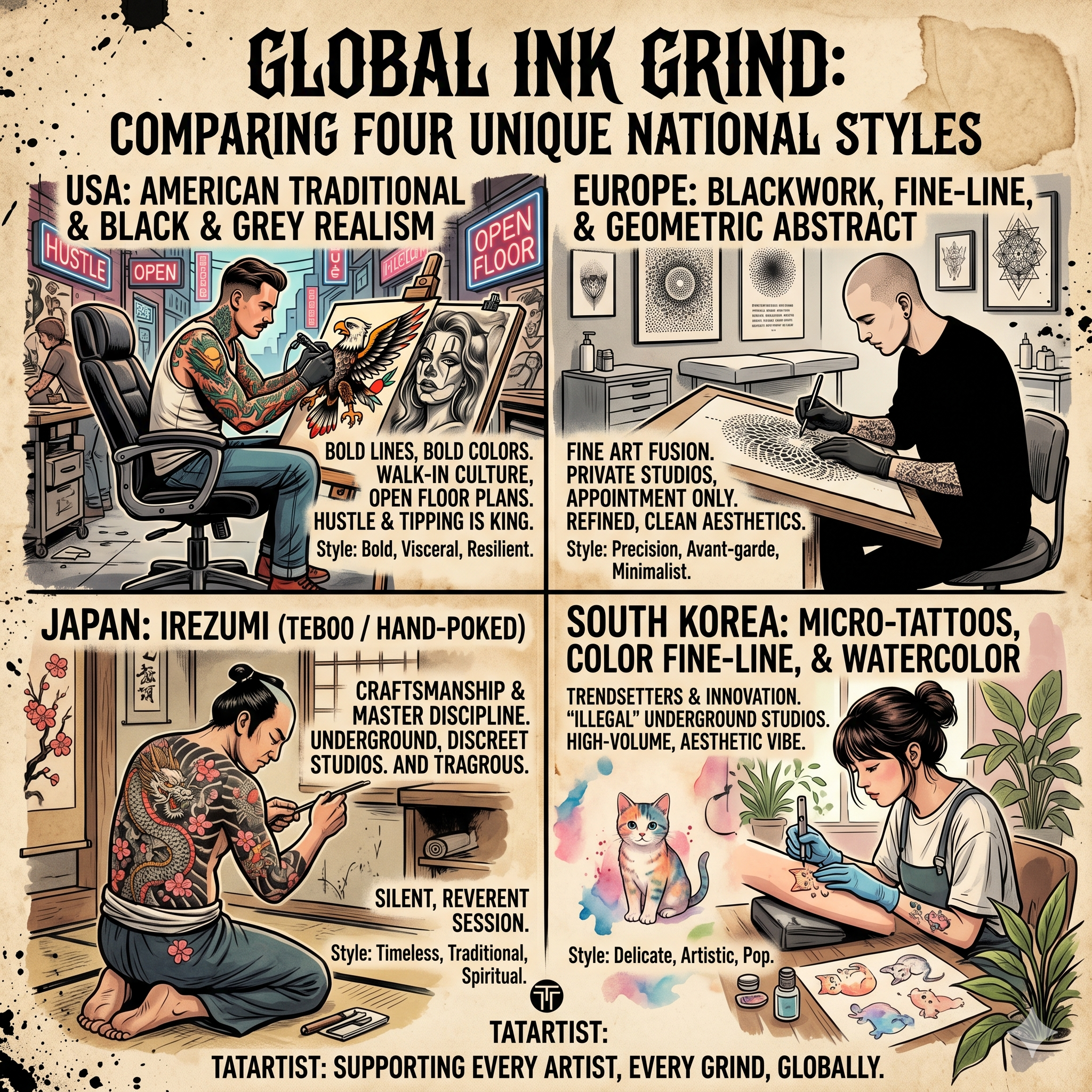
1. 🇺🇸 The United States: Hustle, Heavy Metal, and Tip Culture
The American tattoo scene is deeply rooted in sailor, biker, and street gang history. It is loud, proud, and unapologetic.
The Vibe
Walk into a classic American street shop, and it feels like stepping into a brotherhood. The music (usually heavy metal, punk, or hip-hop) is blasting. The walls are covered floor-to-ceiling in hand-painted flash. Multiple artists are buzzing in an open floor plan, cracking jokes across the room while they work.
The Hustle
In the US, Tipping Culture is King. An artist might charge $200 an hour, but clients are culturally expected to drop an additional 15% to 25% tip at the end of the session. Because of this, American artists aren't just selling art; they are selling an experience. You have to be half-artist, half-therapist, providing maximum emotional value to secure that heavy tip.
The Gear Preference
American artists love Heavy-Duty, Blackout Mechanical Gear. The aesthetic is hardcore. They need robust, indestructible workstations that can handle the high-volume, fast-paced reality of a bustling street shop.
2. 🇪🇺 Europe: Minimalist Galleries and The REACH Regulations
If the US is a loud rock concert, Europe is an exclusive, high-end contemporary art gallery.
The Vibe
The vast majority of top-tier European tattooers operate in Private Studios. It is strictly "Appointment Only." The spaces often look like modern architectural firms—stark white walls, lots of negative space, lush green plants, and ambient electronic music playing softly in the background. It is highly intimate and heavily focused on privacy.
The Hustle
There is virtually no tipping culture in Europe. European artists usually charge a Flat Day Rate or a piece rate. The mentality is: "I am an artist, this is my masterpiece, and the price is the price." Clients pay what is asked and leave. Furthermore, due to the incredibly strict EU REACH regulations that banned thousands of colored ink pigments, European artists have heavily pivoted to dominating the global Blackwork, Trash Polka, and Fine-line scenes.
The Gear Preference
Because their studios look like clinics or galleries, they prefer sleek, highly ergonomic, medical-grade equipment that blends perfectly into a clean, minimalist environment.
3. 🇯🇵 Japan: The Silent Masters of Irezumi
Japan boasts some of the most historically rich and highly respected tattoo artistry on the planet, but it operates completely in the shadows.
The Vibe & The Hustle
Because tattoos are still heavily stigmatized and associated with the Yakuza, traditional Japanese studios are incredibly discreet. There are no neon signs outside. The process of getting a traditional full-body suit (Irezumi) is treated as a solemn, almost religious ritual.
The sessions are long, painful, and often performed in complete silence. The clients have legendary pain tolerance, and the artists possess a monastic, monk-like focus. The physical toll this takes on a Japanese master—often sitting in non-standard postures for hours on end—is immense.
4. 🇰🇷 South Korea: Underground Trendsetters
South Korea presents the most fascinating paradox in the global tattoo industry.
The Vibe & The Hustle
Technically, under South Korean law, it is illegal for anyone without a medical license to perform a tattoo. Because of this, the entire industry operates entirely "underground." Yet, South Korean artists dictate the global trends for ultra-delicate Micro-tattoos and Color Fine-line work.
Despite being illegal, their hidden studios are beautiful. They look like the most aesthetic, sun-lit indie coffee shops in Seoul. They cater to a massive demographic of young, trendy clients, running a high-turnover, highly profitable aesthetic business behind closed doors.
"No matter if you are a traditional artist in a loud American street shop or a fine-line master in a hidden Seoul cafe, the moment you sit down to work, the physical grind is exactly the same."
The Universal Truth: Gravity Hates Your Spine 🦴
Different cultures. Different vibes. Different ways to get paid. But there is one universal truth that unites every single tattoo artist on planet Earth:
The human spine was not designed to hunch over a canvas for 8 hours a day.
A blown-out L4 vertebra doesn't care if you are in Brooklyn, Berlin, or Tokyo. The physical toll of the "Daily Grind" is the great equalizer. That is why top artists worldwide, regardless of their cultural style, are upgrading to professional ergonomic armor.
If you want to survive the grind and protect your career longevity, you need equipment built for the trenches. The Tatartist TA-AC-77 Master Chair features a dynamic chest-support system designed to physically catch your leaning weight, instantly curing the "tattoo hunch." Pair it with the TATC05 Hydraulic Client Bed to ensure your clients—whether they are tough bikers or trendy hipsters—stay locked in, relaxed, and perfectly still.
Protect your art. Protect your body. Because the global grind never stops.
Join the Global Conversation 👇
Which tattoo culture do you relate to the most? If you could pack up your machines and guest spot in any of these 4 countries, where would you go?
Drop your thoughts in the comments!
(And if your back is screaming from the daily grind, hit the links above to upgrade your shop with Tatartist.)