
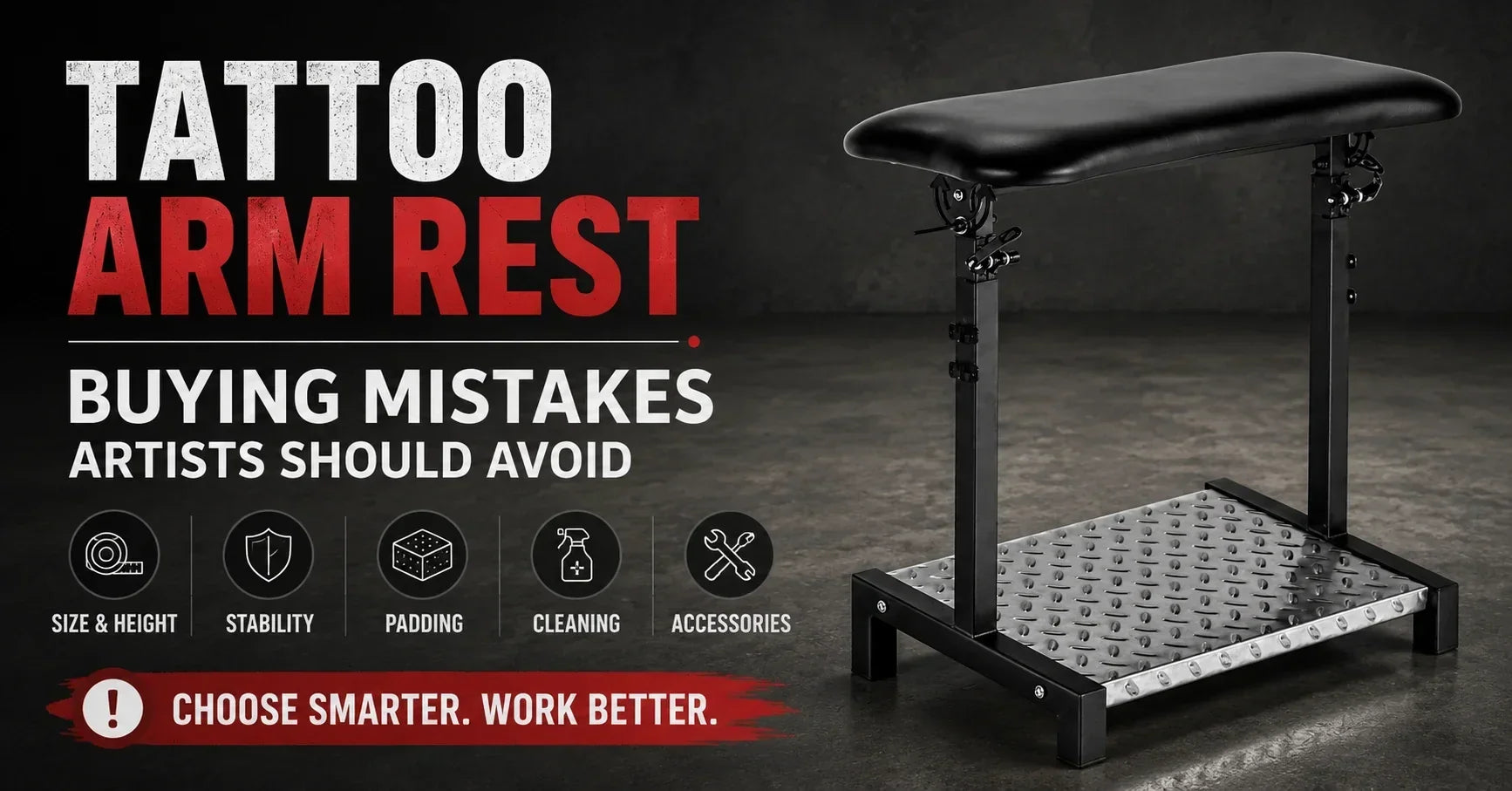
A tattoo arm rest looks like a relatively simple piece of studio furniture. It usually consists of a padded support surface, an adjustable post and a metal base. Because the structure appears straightforward, it can be tempting to compare a few product photos, check the price and order the model that looks the most professional.
The problems often become visible only after the arm rest enters the studio.
The cushion may be large, but the base blocks the artist stool. The product may reach an impressive maximum height, but it cannot go low enough for seated forearm work. The padding may feel soft and comfortable, yet allow the client’s arm or leg to sink and move during a long session.
The right tattoo arm rest should match the artist’s actual workflow, the client positions used most often and the available space around the tattoo chair. Understanding the following buying mistakes can help artists choose equipment that remains practical after it becomes part of the complete workstation.
1. Choosing a Tattoo Arm Rest Based Only on Price
Price is an important part of any equipment purchase, especially when setting up a new tattoo studio. However, the lowest-priced option is not automatically the most economical choice over time.
A tattoo arm rest that cannot reach the required working height, moves under normal pressure or does not fit around the client chair may need to be repaired, replaced or worked around every day.
Price should be evaluated together with:
- Cushion and base dimensions
- Height-adjustment range
- Tilt and rotation
- Frame construction
- Locking mechanisms
- Upholstery and padding
- Maintenance access
- Replacement-part availability
- Warranty terms
This does not mean every affordable arm rest is poorly made or that the most expensive product is always better. The goal is to determine whether the structure and functions match the expected frequency of use.
A private appointment-only studio may have different requirements from a busy multi-artist shop where the same equipment is adjusted throughout the day.
2. Looking at the Cushion but Ignoring the Base
The cushion supports the client, but the base determines whether the arm rest fits into the workstation.
Product photos often focus on the padded top. Buyers may confirm that the cushion looks wide enough while overlooking the shape and dimensions of the structure that sits on the floor.
An unsuitable base can:
- Collide with the tattoo-chair pedestal
- Block the artist stool
- Push the foot pedal into an awkward position
- Restrict access from one side of the client
- Obstruct the client’s entry and exit path
- Interfere with a workstation trolley or task-light base
Before ordering, record both the cushion dimensions and the complete base footprint. Clear product specifications should ideally include both imperial and metric measurements so the available space can be checked accurately.
Use painter’s tape to mark the dimensions on the studio floor. Place the client chair, artist stool, foot pedal and workstation around the marked area. Then simulate how the artist would approach the client from the front, side and rear.
Repeat the test with the client chair upright, partially reclined and fully reclined. A base that fits comfortably in one position may become an obstacle when the chair moves.
The cushion supports the client, but the base determines whether the arm rest fits the studio.
3. Assuming the Largest Cushion Is Always Better
An XL cushion can provide valuable support for full forearms, upper arms, calves and longer appointments. It may also accommodate a wider range of client body types.
However, a larger cushion is not automatically the correct choice.
An oversized support pad may:
- Occupy more space than the studio can comfortably provide
- Prevent the arm rest from moving close enough to the client
- Collide with a trolley, chair or task light
- Make smaller wrist and hand positions less convenient
- Add unused surface area without improving support
- Restrict movement around the client chair
Start with the tattoo placements performed most often.
A studio specializing in small hand, wrist and forearm work may not need the same support area as an artist regularly completing sleeves, upper-arm pieces or calf tattoos.
Also consider whether the cushion can rotate or tilt. A well-positioned medium-size pad may be more practical than a larger fixed surface.
The best cushion is not the largest one. It is the size that supports the client without restricting the artist’s movement.
4. Focusing Only on Maximum Height
Maximum height is one of the easiest specifications to compare, but it does not show whether the full working range is useful.
The minimum height can be equally important for:
- Seated tattooing
- Hand and wrist placements
- Forearm work
- Reclined client-chair positions
- Calf and ankle support
- Lower artist stools
The maximum height matters when:
- The artist works while standing
- The client remains upright
- The tattoo chair has a high seat position
- The working area needs to be raised
- Upper-arm or shoulder support is required
Measure the actual height of the client’s supported limb in several common setups. Check the chair in both upright and reclined positions, and measure while the artist is seated and standing.
A wide adjustment range has little value if the studio never uses its upper section. Similarly, a product with an impressive maximum height may still be unsuitable when its minimum setting is too high.
The most useful height range is the one that covers the studio’s real working positions.
5. Choosing an Adjustment System Without Considering Workflow
Tattoo arm rests commonly use manual adjustment or a pneumatic air-rod system. Neither method is universally better.
The correct choice depends on how frequently the artist changes the height and position.
Manual adjustment
Manual controls may suit a studio where the arm rest is positioned before the appointment and remains at approximately the same height throughout the session.
Before buying, check:
- Whether the controls are easy to reach
- Whether adjustment requires one or two hands
- How firmly the position locks
- Whether the mechanism remains secure after repeated use
- Whether handles and knobs can be cleaned easily
Air-rod adjustment
A pneumatic system can make height changes more convenient when several clients or artists use the same station.
It may be useful when:
- Different artists share the equipment
- The studio handles several placements each day
- The support is repositioned during an appointment
- The client-chair height changes frequently
An air rod may make adjustment faster, but its working range must still match the client chair and artist position.
Choose according to adjustment frequency rather than assuming that the more advanced-sounding system is automatically the better one.
6. Assuming Every Tattoo Arm Rest Can Support a Leg
A wide cushion does not automatically make an arm rest suitable for leg tattooing.
A calf or lower leg places more pressure on the cushion and frame than a hand or forearm. The position may also shift the client’s weight farther toward one side of the support.
Before using an arm rest for legs, confirm:
- The manufacturer’s stated application
- Cushion length and width
- Base stability
- Frame construction
- Post and bracket connections
- Tilt-lock strength
- Client knee and ankle positioning
- Whether the limb can rest without sliding
Avoid making a decision from the product name alone.
Some products described as arm rests are designed for both arms and legs. Others are intended only for lighter upper-body support. The stated use and construction details matter more than appearance.
Intended use matters more than cushion size when deciding whether an arm rest can support a client’s leg.
7. Judging Stability Only by Product Weight
A heavier base can contribute to a more planted feel, but weight is only one part of stability.
A heavy tattoo arm rest can still wobble when:
- The center post is loose
- The cushion bracket is not fully locked
- Fasteners have not been tightened correctly
- The floor is uneven
- Pressure is applied far from the center
- The stand becomes top-heavy at maximum height
Stability depends on the complete structure:
- Base geometry
- Floor contact
- Metal tubing
- Post connection
- Fasteners
- Tilt and rotation locks
- Cushion mount
- Correct assembly
After assembly, place the arm rest at a normal working height and apply controlled pressure to the center, ends and sides of the cushion.
Check whether the base lifts, slides or rocks. Confirm that the cushion remains in position after the adjustment lock is tightened.
Repeat the test at the highest setting expected to be used. Raising the cushion changes the leverage placed on the frame, so stability should not be evaluated only at the lowest height.
A heavy arm rest can still move when its joints, locks or assembly are not secure.
8. Choosing the Softest Cushion
A soft cushion may feel comfortable during a quick product test, but tattooing requires both comfort and positional control.
Padding that is too soft can allow the client’s arm or leg to:
- Sink into the cushion
- Roll toward one side
- Sit lower than the artist intended
- Change position as the session continues
- Require frequent correction
Padding that is excessively firm may create concentrated pressure during a longer appointment.
A practical cushion should distribute pressure while keeping the limb stable. It should also recover after the client’s weight is removed.
Press several areas of the cushion and compare the response. The center and edges should feel reasonably consistent. After releasing the pressure, the foam should return toward its original shape rather than remaining deeply compressed.
The thickest cushion is not necessarily the most supportive. Foam density, firmness, edge support and recovery all matter.
Cushion comfort should be balanced with positional stability.
9. Ignoring the Complete Upholstery Construction
Product pages often identify the surface as PU or PVC, but the material name alone does not explain how the cushion will perform during daily studio use.
Inspect:
- Surface texture
- Seam location
- Edge construction
- Decorative stitching
- Underside finishing
- Areas where residue could collect
- How easily barrier film can be secured
- Whether the cushion can be replaced
A heavily textured surface may be harder to wipe. Deep seams and decorative channels can create areas that require more attention. Loose upholstery around the corners may make wrapping less secure and can deteriorate faster.
The surface should not be judged only by how premium it looks in a photograph.
Consider how it will respond to:
- Repeated wrapping
- Client pressure
- Frequent wiping
- Approved cleaning products
- Long-term use
- Regular inspection
Material labels matter less than the complete upholstery construction and its performance in the studio.
10. Adding Too Many Accessories
Tool trays, paper towel holders, ink holders and tablet mounts can make a workstation appear more complete. They can also introduce new problems.
Accessories may:
- Increase the total footprint
- Block the client’s arm or leg
- Interfere with the artist stool
- Cover an adjustment handle
- Add more surfaces that require cleaning
- Make repositioning more difficult
- Mix clean and used items in one area
- Change the balance of the structure
Before adding an attachment, ask whether it solves a repeated workflow problem.
A paper towel holder may be useful when there is no practical wall or trolley location. A large tool tray may be unnecessary when a separate workstation already sits within easy reach.
Accessory compatibility does not mean every available attachment is needed.
Also confirm what is included with the standard product. Product images may show optional trays, holders or storage components that are sold separately.
Add accessories because they improve the workflow, not simply because mounting points are available.
11. Buying Without Measuring the Full Workstation
A tattoo arm rest does not operate alone. It shares the working area with furniture, equipment, cables, the client and the artist.
Measure the complete station, including:
- Client chair or tattoo bed
- Artist stool
- Tattoo arm rest
- Workstation trolley
- Foot pedal
- Task light
- Power supply and cables
- Waste container
- Paper towel holder
- Client walkway
Test the layout in every client-chair position used by the studio:
- Upright
- Partially reclined
- Fully reclined
- Raised
- Lowered
- Rotated, when applicable
A station may feel open when the chair is upright but become crowded when it reclines. The arm rest may work well for a forearm tattoo but block the artist’s knees when repositioned for a calf.
Also consider the client’s movement. The client should be able to approach and leave the chair without stepping over the arm-rest base, foot pedal or electrical cables.
Floor markings can expose these conflicts before the product is ordered.
A workstation should be tested in every chair position used by the studio, not only with the chair upright.
12. Ignoring Maintenance Access
An arm rest may work well when new but become difficult to maintain if its service points are inaccessible.
Before buying, check whether:
- Fasteners can be inspected
- Adjustment knobs can be tightened or replaced
- The cushion can be removed
- The upholstery pad can be replaced
- Mechanical or pneumatic components can be serviced
- Base connections remain accessible
- Assembly instructions are provided
- Spare-part information is available
- Warranty coverage is clearly stated
In a high-use studio, adjustment controls and upholstery may show wear before the main metal frame.
A product should not become unusable because one small component cannot be accessed or replaced.
Maintenance access is part of product usability, especially in a professional studio.
13. Trusting Marketing Claims Without Checking Specifications
Terms such as “heavy-duty,” “professional,” “XL,” and “ergonomic” are common in product listings, but they should be supported by clear specifications.
Before ordering, confirm:
- Cushion and base dimensions
- Height and angle ranges
- Adjustment method
- Frame and upholstery materials
- Included and optional accessories
- Intended applications
Choose from verified specifications, not marketing terms alone.
Final Tattoo Arm Rest Buying Checklist
Before purchasing, confirm that:
- The cushion and base fit the workstation.
- The height range suits your usual working positions.
- Tilt, rotation, and locking controls work securely.
- The frame remains stable under normal pressure.
- The padding supports the limb without excessive sinking.
- The upholstery suits the studio’s cleaning routine.
- Optional accessories do not restrict movement.
- Maintenance and replacement information is available.
Is an XL tattoo arm rest suitable for every studio?
No. An XL cushion can support larger tattoo areas and longer limbs, but it also requires more floor space. Measure both the cushion and base before ordering.