
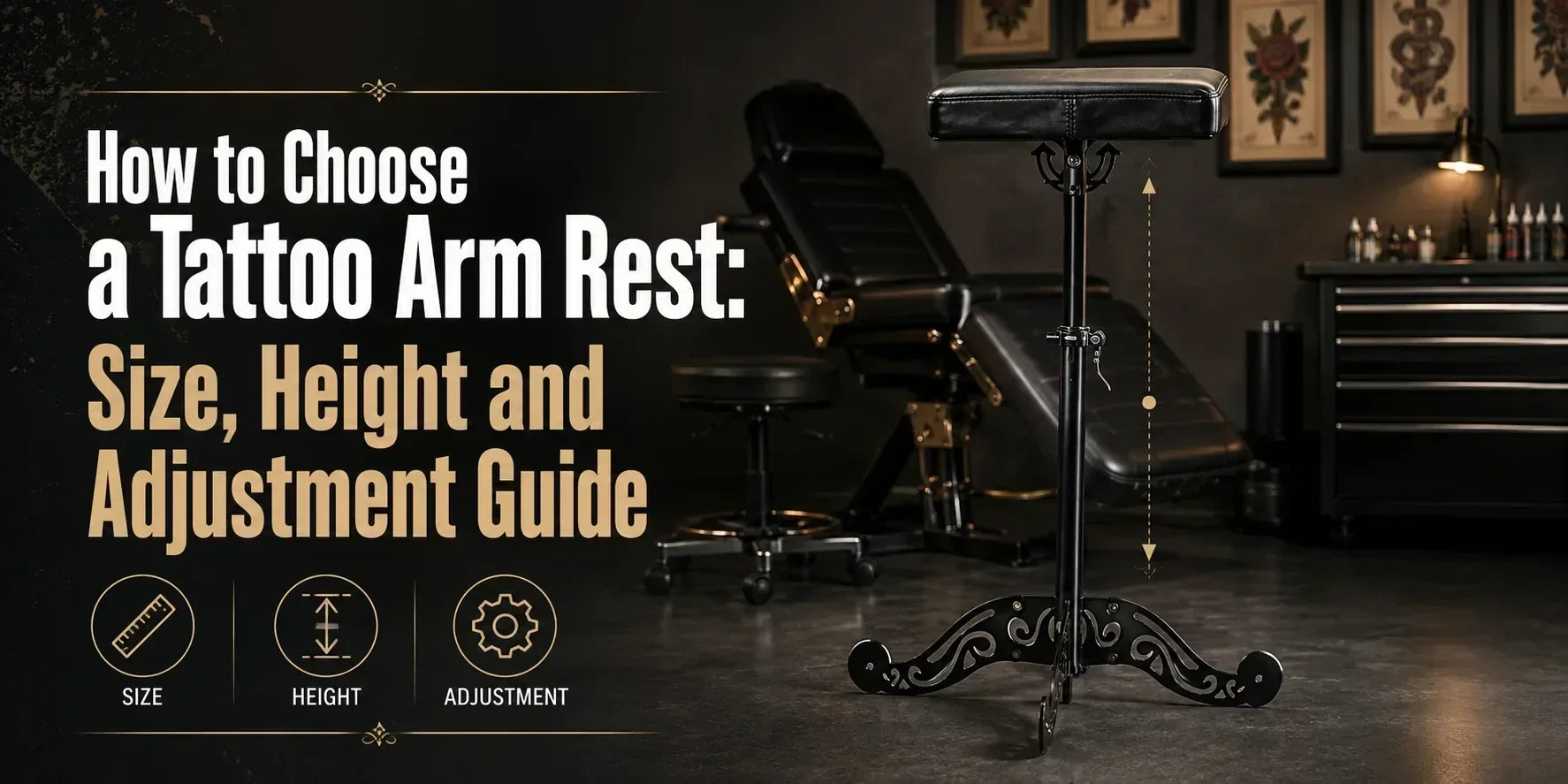
How to Choose the Best Tattoo Arm Rest for Your Studio in 2026
A tattoo arm rest may look like a simple support, but its dimensions and adjustment system can affect how easily the client is positioned and how comfortably the artist can reach the tattoo area.
A suitable arm rest should support the client’s limb without requiring them to actively hold it in place. It should also allow the artist to bring the working area closer instead of repeatedly moving the client chair, leaning across the client or stopping to correct the position.
However, there is no single tattoo arm rest size or height that works for every artist. The right choice depends on the body areas you tattoo, the height of your client chair, whether you work seated or standing and how often the support needs to be repositioned.
This guide focuses on three key factors:
- Cushion size
- Working height
- Tilt, rotation and adjustment method
Stability, upholstery, workstation layout and maintenance will be covered in Part Two of this guide.
1. Start With the Tattoo Placements You Work On
Before comparing measurements, consider how the tattoo arm rest will be used during a normal working week.
An artist who mainly works on hands and forearms may need a different setup from an artist who regularly tattoos upper arms, shoulders, calves or feet.
Hands, Wrists and Forearms
For smaller upper-body placements, the support pad should keep the client’s hand or forearm stable while allowing the artist to approach from either side.
The client should not need to hold the arm in the air or keep the muscles tense throughout the appointment. Even during a small tattoo, repeated movement can interrupt the workflow and change the artist’s working angle.
Important features include:
- A practical minimum height
- Enough cushion width to reduce rolling
- Secure pad positioning
- Space for the artist stool
- Clear access to the inner and outer forearm
The support should be close enough to the client chair that the arm can rest naturally, but it should not push the metal base into the artist’s working area.
Upper Arms and Shoulders
Upper-arm and shoulder tattoos often require more flexible positioning.
Depending on the placement, the client may be sitting upright, partially reclined or turned slightly to one side. The arm may also need to be rotated during the appointment to expose the inner arm, outer arm, elbow area or shoulder.
A cushion that tilts and rotates gives the artist more options without requiring the complete base to be moved each time.
For these placements, pay attention to:
- The available tilt range
- How securely the pad locks
- Whether the cushion can rotate
- Whether the base remains clear of the client chair
- Whether the arm can be supported without lifting the shoulder
Calves, Ankles and Feet
Some tattoo arm rests can also support the lower leg, but this should not be assumed for every product.
A leg places more pressure on the cushion and frame than a wrist or forearm. For lower-body placements, check the cushion dimensions, base structure, locking system and intended product application.
The TATARTIST TA-AM-19 is designed as an XL arm-and-leg support. Its current product page lists a 70 × 32 cm cushion, an adjustable height of 68–108 cm, a 55 × 35 cm base and a total product weight of 12 kg. The page also identifies the support for arms, legs and feet.
This type of larger support area can be useful for studios that regularly handle calves, ankles, feet or other placements requiring more of the limb to rest on the cushion.
2. Choose a Cushion Size That Matches Your Work
Cushion size affects both client support and the amount of space the arm rest occupies.
A longer cushion can support more of the forearm or lower leg. A wider cushion gives the client more room to settle into position and may accommodate a broader range of body types.
An XL tattoo arm rest may be useful for:
- Full forearms
- Upper arms
- Sleeve projects
- Calves
- Ankles and feet
- Larger clients
- Longer tattoo appointments
However, a larger cushion is not automatically better.
If the arm rest is too large for the room, the base may block the artist stool, foot pedal or client walkway. The artist may then have to work around the furniture rather than using it naturally.
Measure More Than the Cushion
Product images can make an arm rest look smaller than it is. Before ordering, check both the cushion and base dimensions.
Measure the area around:
- The client chair
- The artist stool
- The foot pedal
- The workstation tray
- The task light
- Power cables
- The client entry path
A practical method is to mark the listed cushion and base dimensions on the floor with painter’s tape.
Place the existing furniture around the marked area and simulate the artist’s usual movements. Check whether the tattoo area can be approached from the front, side and rear without stepping over the base or moving the foot pedal.
The right cushion size provides enough support while still leaving space for the artist to work.
3. Select a Practical Working-Height Range
There is no universal ideal height for a tattoo arm rest.
The correct working position depends on:
- Artist height
- Artist-stool height
- Client-chair height
- Seated or standing work
- Tattoo placement
- Cushion angle
- Client body type
The support should bring the tattoo area closer to the artist. It should not force the artist to continuously raise the shoulders, hold the working elbow in the air or lean excessively across the client.
Check Both Minimum and Maximum Height
Many buyers focus on maximum height, but the minimum height may be equally important.
A lower setting may be needed for:
- Seated forearm work
- Wrist and hand tattoos
- Reclined client positions
- Lower client chairs
- Calf and ankle positioning
A higher setting may be useful when:
- The client is sitting upright
- The artist is working while standing
- The client chair has a higher seat
- The tattoo area needs to be brought closer to eye level
The TA-AM-20 product page lists a working-height range of 68–108 cm. Its height is manually adjusted and secured as part of the arm rest’s positioning system.
A broad range can be useful, but only when the artist will realistically use both ends of it. The most suitable range is the one that matches the studio’s actual client chair and working positions.
Measure Your Existing Setup
Before selecting a product, measure the approximate height of the client’s supported limb in several common situations:
- Client sitting upright
- Client partially reclined
- Artist working from a stool
- Artist working while standing
- Forearm resting horizontally
- Calf or ankle supported at an angle
These measurements provide a more reliable reference than choosing the product with the largest advertised range.
4. Understand Cushion Tilt
Tilt adjustment changes the angle of the supported limb.
A flat pad may work well for forearms, but angled support can be useful for areas that cannot remain comfortably positioned on a horizontal surface.
Common examples include:
- Inner forearms
- Elbows
- Upper arms
- Shoulders
- Calves
- Ankles
- Feet
The listed tilt range is only one part of the decision. The cushion must also remain secure after the client places weight on it.
When checking an arm rest, consider:
- How the tilt is adjusted
- Whether the control is easy to reach
- Whether the position locks firmly
- Whether the pad moves under pressure
- Whether the angle can be reset consistently
The TA-AM-20 is listed with a 0–30° cushion tilt range. Its manual positioning system allows the artist to set the working angle and secure the pad before beginning the tattoo.
Do not choose an arm rest only because it has a larger stated angle. The useful range is the one that covers the positions used in your studio and remains stable during the appointment.
5. Consider Cushion Rotation
Rotation allows the direction of the support pad to change without lifting and turning the complete arm-rest base.
This can be particularly useful when changing between:
- Inner and outer forearm positions
- Horizontal and diagonal arm support
- Upper-arm and shoulder work
- Arm and lower-leg positioning
The TA-AM-19 product page lists 180° cushion rotation, while the TA-AM-20 page also lists a 0–180° rotation range.
When evaluating rotation, check whether:
- The pad turns smoothly
- The control is easy to operate
- The cushion locks after repositioning
- The pad twists when pressure is applied
- Rotation can be adjusted without moving the base
Rotation is valuable when it improves access. It should not introduce additional movement into the supported limb.
6. Choose the Right Adjustment Method
Tattoo arm rests may use manual controls or a pneumatic air-rod system to change the working position.
The adjustment method does not determine the overall quality of the product. It mainly affects how the artist interacts with the support during the working day.
Manual Adjustment
A manually adjusted arm rest allows the artist to position the support through mechanical controls and then lock it in place.
This type of system can suit studios where:
- The setup is established before the tattoo begins
- The height changes infrequently
- The artist prefers direct mechanical control
- The support remains in one main position during the session
The TA-AM-20 uses manual height, tilt and rotation adjustment. Its current product page lists a 68–108 cm height range, 0–30° tilt and 0–180° cushion rotation.
The main consideration is whether the controls remain easy to reach and secure after repeated use.
Air-Rod Adjustment
An air-rod system uses a pneumatic telescopic rod to change the working height.
This can make height changes more convenient when:
- Several clients use the station each day
- Artists of different heights share the equipment
- The support moves between different body areas
- The height is changed during an appointment
The TA-AM-21 product page lists a pneumatic height range of 70–96 cm, a 69 × 31 cm cushion, 0–20° inclination and 0–180° cushion rotation.
An air-rod system may make adjustment quicker, but the listed working range still needs to fit the client chair and artist position.
The right choice depends on how frequently the height changes—not on assuming that one mechanism is universally better.
7. Buying Checklist for Size, Height and Adjustment
Before choosing a tattoo arm rest, confirm the following:
Cushion Size
- Is the pad long enough for the body areas you tattoo?
- Is it wide enough to reduce limb rolling?
- Will the cushion fit around the client chair?
- Do you need arm-and-leg support?
Working Height
- Is the minimum height low enough?
- Is the maximum height genuinely useful?
- Does the range suit seated and standing work?
- Will it work when the client chair is reclined?
Tilt and Rotation
- Does the tilt range cover your common placements?
- Does the pad lock securely?
- Can the cushion rotate without moving the base?
- Does it remain stable when pressure is applied?
Adjustment Method
- Will the height remain mostly fixed?
- Does the support need to be changed frequently?
- Are the controls easy to reach?
- Does the chosen mechanism fit the studio workflow?
Frequently Asked Questions
What size tattoo arm rest should I choose?
Choose according to the body areas you tattoo and the available floor space. A larger cushion may be useful for full forearms, upper arms and lower legs, but the base must still fit around the client chair, artist stool and foot pedal.
What height should a tattoo arm rest be?
There is no single correct height. The support should place the tattoo area within comfortable reach while fitting the client-chair position and the artist’s seated or standing posture.
Is a larger cushion always more comfortable?
Not necessarily. The cushion also needs suitable foam support and enough stability to prevent the limb from sinking or rolling. It must also fit the available studio space.
Conclusion
Choosing the right tattoo arm rest starts with the work performed in your studio.
Identify the body areas you tattoo most often, then compare the cushion size, working-height range, tilt, rotation and adjustment method. Measure the complete workstation rather than judging the product from photos alone.
The best tattoo arm rest is not simply the one with the largest cushion or widest range. It is the model that supports the client, keeps the tattoo area accessible and fits naturally into the artist’s daily workflow.